
Does Your Gold Plating Look Different Every Week?
Seeing slight colour changes in your gold plating from batch to batch? It’s often not technique, but subtle bath variability. This blog explains where that drift starts and how a stable, ready-to-use flash gold solution can help keep your 24KT colour consistent, week after week.
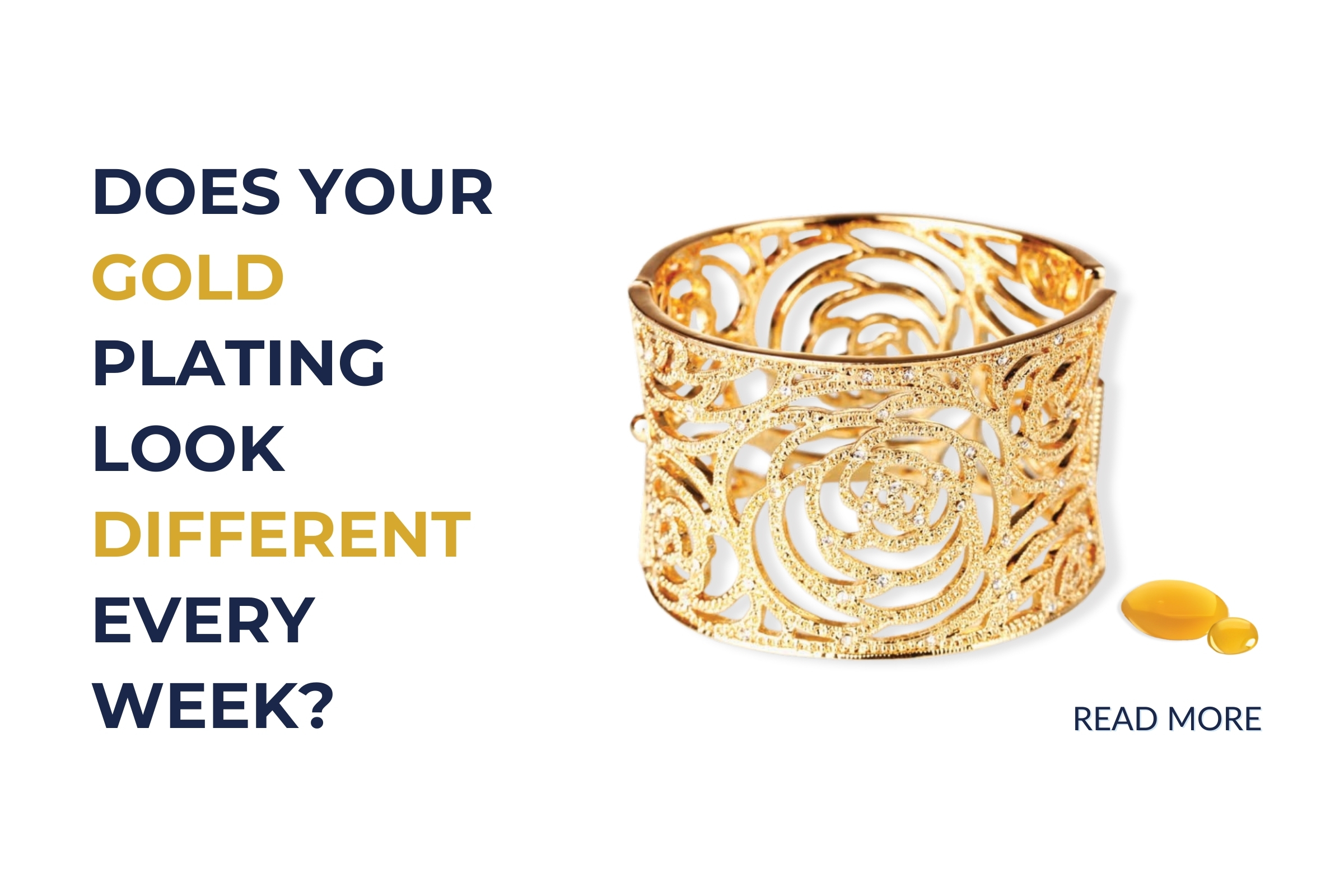
You line up two trays from two different plating runs under the same light and you can feel it immediately: “Arre, yeh shade thoda sa off kyun lag raha hai?” If you’ve ever had that moment, you’re not imagining it.
On Monday, production comes out exactly right. Rich, warm gold - the kind of 24KT yellow that photographs well and sells itself. Phir Thursday rolls around and somehow the “same” process gives you a slightly paler undertone. Sometimes it even leans greenish, and no amount of polishing will fix it. Same-same… but not the same.
The first reaction is to blame technique. Sabse pehle temperature check. Timing pe doubt. Rinse step miss toh nahi hua? Maybe the new person on the line didn’t follow the SOP exactly. But when you’ve ruled all that out and the drift keeps showing up, you start asking a better question: what changed between batches that nobody is tracking?
Often, it’s the plating solution itself - not in a dramatic way, but in small, cumulative ways.
The hidden “chalta hai” tax of “close enough”
Colour variation in flash gold plating doesn’t stay in the plating room. It travels downstream - into dispatch, QC, rework, and those awkward customer conversations nobody enjoys.
When pieces from different batches don’t match, you can’t ship them together. A retailer ordering fifty bangles expects fifty identical bangles - buyer ko ‘almost same’ nahi chahiye. So you sort and hold stock until you have enough matching pieces, or you rework. Either way, margin takes a hit.
Then there’s the QC overhead. When colour is unpredictable, someone ends up checking every batch more closely. That’s time, and it also creates friction between production and quality teams - a push-pull nobody wants. (If you’ve run a line, you know how quickly that mood spreads.)
And if inconsistent pieces do reach customers? Returns. Complaints. And you’re spending energy explaining something that should never have become a discussion.
Where the drift really starts: dilution, top-ups, and human hands
Most flash gold solutions come as concentrates: dilute to a certain ratio, maintain the bath, replenish as needed. Straightforward enough in theory. And yes - market mein RTU options bhi mil jaate hain, so it’s not just a “concentrate vs ready-to-use” debate. What matters is what happens around the chemistry: trials, line-fit, operator training, and the handholding that turns a promising trial into stable day-to-day manufacturing.
In practice, dilution is where things start to drift. A slightly different water quality. A measurement that’s off by a few percent. An operator who eyeballs the ratio because they’ve done it a hundred times. None of these feel like big errors - bas thoda sa idhar-udhar. But in electroplating, small differences compound. The bath that ran perfectly last week behaves slightly differently this week, even though nothing obvious changed. This is exactly why we pair the chemistry with technical support and handholding - from trials, to line stabilisation, to helping your operators lock in the same results week after week.
Add to this the gold concentration question. Higher gold content in the bath generally means faster deposition and richer colour, but also more precious metal tied up in working capital. So there’s constant pressure to run leaner - ‘cost bachaao’ mode - which creates its own variability. The margin between “efficient” and “too thin” is narrower than it looks.
A steadier baseline with GF24 (less guesswork, more repeatability)
.jpg)
GF24 is a flash gold plating solution that’s built to reduce the variables that cause drift. We are Legor’s exclusive distribution partners in India, which puts us in a unique spot: you’re not just getting the chemistry, you’re getting specialised expertise and on-ground support in this space and market. In plating, the saying “measure twice, cut once” applies in a different way - start stable, and the rest of the line becomes easier to control. Simple bolun toh: pehle baseline sahi karo.
It comes ready to use. No dilution required. You open it, pour it into the tank, heat to temperature, and plate - bas. No mixing drama, no ‘kitna pani dala?’ debate. The concentration is fixed at 0.8 g/L gold, which is low enough to keep bath cost manageable but calibrated to deliver full 24KT yellow colour. The coordinates are documented, L* 86.3, a* 5.6, b* 35.7, so you have something objective to measure against rather than relying on visual judgment alone.
This doesn’t replace good surface preparation (more on that below). But it does remove the prep-step variability, so your senior technician and your newest trainee are starting from the same baseline. In practical terms: you’re far more likely to see Tuesday’s colour line up with Friday’s, and that predictability changes how you can plan production.
Compliance, without the last-minute panic
GF24 is formulated without nickel, lead, or cadmium. For manufacturers exporting to the EU, US, or Asian markets with strict material regulations, this removes a recurring documentation headache. You’re not scrambling for compliance certificates or testing reports because the chemistry is clean from the start.
If you’ve been caught out on material compliance once, you know it isn’t “just paperwork.” Once bitten, twice shy. Requirements keep tightening, and being caught out is expensive in ways that go beyond the immediate shipment.
What GF24 won’t magically fix
A consistent plating solution doesn’t compensate for poor surface preparation. It won’t fix contaminated rinse water or worn-out anodes. The pre-treatment steps still matter enormously - degreasing, activation, proper rinsing between stages. Yahan ‘jugaad’ nahi chalta; discipline hi kaam aata hai.
What it does is take one variable off the table. If you’ve optimised your process and you’re still seeing colour drift, the plating bath itself might be where to look.
If this sounds familiar on your line
If you want, we can share the full technical data sheet, walk through your specific setup, and support your team through trials right up to stable manufacturing - no gyaan, just practical help. We’ll stay with you until it’s running sahi. No obligation, no pressure, just a quick conversation about whether this addresses what you’re experiencing.
Reach out: help@preciousalloy.com | +91 22 6101 4444
Advancements in Electroplating Technology for Luxury Accessories
How new plating techniques are enabling unprecedented finishes and durability in high-end consumer products.
.jpg)
.jpg)
.jpg)
FAQs
We’ve answered the big questions, but if you still have something on your mind, we’re here to help.
What does Precious Alloys Pvt. Ltd. specialize in?
Precious Alloys Pvt. Ltd. is a B2B solutions provider specializing in advanced casting machines, in-house alloy manufacturing, Legor’s plating solutions, Invicon investment rings, and platinum casting technologies.
Who are the typical clients of Precious Alloys Pvt. Ltd.?
We serve jewelry manufacturers, industrial casting units, precision engineers, and large-scale refineries looking for reliable, high-performance casting and alloying solutions.
Where are your services available?
We are available in most Tier 1 and Tier 2 cities across PAN India. Whether you're in metro hubs or emerging regional centers, our team ensures efficient service with consistent quality and support.
Where is Precious Alloys located, and do you serve clients across India?
Our head officeis located in Mumbai, and we serve clients nationwide through a strong regionalnetwork. We also support international inquiries about select offerings.Wherever you're based, we’re equipped to deliver.
What kind of technical or after-sales support do you offer?
We provide end-to-end technical support—from product selection and process setup to troubleshooting and training. Our regional experts ensure timely assistance to keep your operations running smoothly.
What industries does Precious Alloys serve?
Precious Alloys primarily serves the jewelry manufacturing industry, supporting processes like casting, plating, and alloy development. We also cater to exporters, OEMs, and businesses in high-precision metalwork requiring specialized materials and equipment.
What makes Precious Alloys different from other suppliers in the industry?
We offer in-house manufacturing, faster delivery, consistent quality, and expert support—combining global standards with local reliability.
Can you customize alloy formulations for specific client needs?
Absolutely. Our metallurgical team collaborates closely with clients to develop custom alloys based on color, hardness, melting point, and other application-specific requirements.
What kind of training or support do you offer post-sale?
We offer on-site installation, operator training, process optimization, and ongoing technical support to ensure you get the best performance and ROI from our machines and materials.
How do Precious Alloys help manufacturers improve production efficiency?
We integrate casting machines, optimized alloys, and plating solutions into a seamless workflow, reducing metal loss, cycle times, and rework—leading to higher throughput and consistent product quality.