
The Real Reason Your Platinum Casting Results Are Inconsistent
Inconsistent platinum casting results often come from alloy variation, not technique. Learn how stable composition and uniform granules, like in BH950RP1, can bring true consistency to your production.
I've had this conversation so many times now.
Sitting in a manufacturer's office somewhere in India, chai getting cold on the table, listening to someone walk me through months of frustration. They've been adjusting temperatures. Swapping flask positions. Second-guessing their own team's skills. Running the same troubleshooting loop over and over.
Then, finally, the realisation: the problem wasn't technique at all. It was the platinum alloy varying just enough, batch to batch, to make everything unpredictable.
It's a frustrating moment. Because you can't troubleshoot your way out of inconsistent raw material.
The thing we blame last (but probably shouldn't)
When casting results go wrong, the instinct is to look at the process. Temperature. Timing. Technique. And yes, these absolutely matter.
But here's the thing: focusing on process assumes there's a constant underneath it all. That the metal itself behaves the same way every time. And with traditional platinum alloys, especially those requiring manual preparation, that assumption often doesn't hold.
Small differences in mixing. Slight inconsistencies in composition. Variations in size that change how the metal flows and melts. None of these seem dramatic on their own. But they compound. By the time you're polishing a finished piece, you're dealing with the accumulated effect of decisions made much earlier.
What actually makes a difference on the floor
I've spent enough time in production facilities to know that "consistent results" isn't about perfection. It's about reducing the variables you can control, so you can focus on the ones that genuinely need human judgment.
For platinum casting, that comes down to a few things:
- The format of your raw material.
Uniform granules melt evenly and weigh precisely. Sounds basic, but the downstream effects are real, less over-pour, more predictable fill, fewer surprises when you crack open the flask.
- Composition stability.
Colour and hardness that drift between batches create headaches you feel everywhere. Your polishers adjust their technique for one batch, then the next one behaves differently. Your stone-setters develop muscle memory for a certain hardness, then it changes on them. Suddenly skilled craftsmen look inconsistent, when actually, the material is.
- Preparation overhead.
Every step of manual prep is a chance for variation. It's also time your team spends just getting to a starting point, time that doesn't add value to the final piece.
The real cost of "chalta hai"
Here's what doesn't get talked about enough: a lot of manufacturers have simply normalised inconsistency.
The rework rate becomes "just how it is." The colour variation between pieces becomes "close enough." The occasional customer return for skin sensitivity becomes "unavoidable."
These aren't failures of skill or effort. They're often just what happens when you're working with materials that weren't designed for consistency in the first place.
The question worth sitting with: what would change if that variable were removed?
What we learned (the hard way)
We manufacture platinum alloys, so I'll be upfront, I have a perspective here. But that perspective comes from years of listening to what actually causes problems on production floors. Not what should cause problems in theory.
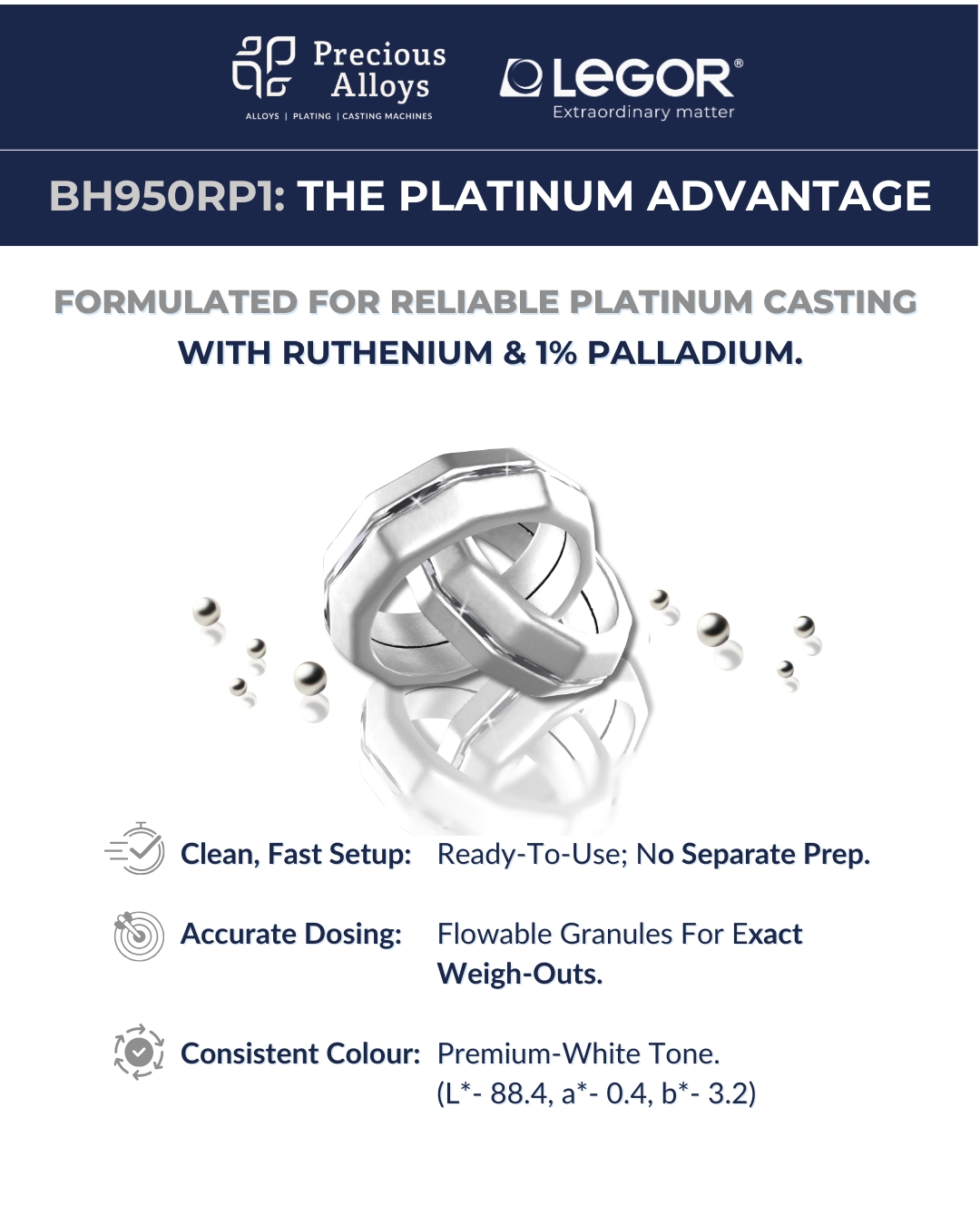
The alloy we developed, BH950RP1, exists because of specific headaches that kept coming up in conversation:
- The panic when colour matches the first batch but drifts by the fifth.
- The struggle with hardness that varies enough to ruin a finish.
- The frustration of prep time eating into actual productive hours.
- The disappointment of returns from customers with sensitive skin.
It's a PT950 ruthenium-palladium formulation, supplied as ready-to-use granules. PGI certified. The specs are documented: HV 165.0, colour values of L*- 88.4, a*- 0.4, b*- 3.2.
But honestly? Specs are just numbers on a sheet. What actually matters is whether your polisher gets the same feel batch after batch. Whether your stone-setter can trust the metal. Whether your customer can wear the piece without their skin reacting.
What this won't fix
I should be clear about limitations.
A better alloy doesn't fix poor casting technique. It doesn't compensate for equipment that needs maintenance. It won't make an inexperienced team suddenly expert.
What it does is remove one variable from a complicated equation. For manufacturers who've already optimised their process and are still seeing drift, that might be exactly what's needed. For others, it might be one piece of a larger puzzle.
If you're curious
Happy to share technical data, talk through your specific situation, or send a small sample for testing. No pitch, no pressure, just a conversation about whether this might help with what you're experiencing.
Reach out: help@preciousalloy.com | +91 22 6101 4444
Advancements in Electroplating Technology for Luxury Accessories
How new plating techniques are enabling unprecedented finishes and durability in high-end consumer products.
.jpg)
.jpg)
.jpg)
FAQs
We’ve answered the big questions, but if you still have something on your mind, we’re here to help.
What does Precious Alloys Pvt. Ltd. specialize in?
Precious Alloys Pvt. Ltd. is a B2B solutions provider specializing in advanced casting machines, in-house alloy manufacturing, Legor’s plating solutions, Invicon investment rings, and platinum casting technologies.
Who are the typical clients of Precious Alloys Pvt. Ltd.?
We serve jewelry manufacturers, industrial casting units, precision engineers, and large-scale refineries looking for reliable, high-performance casting and alloying solutions.
Where are your services available?
We are available in most Tier 1 and Tier 2 cities across PAN India. Whether you're in metro hubs or emerging regional centers, our team ensures efficient service with consistent quality and support.
Where is Precious Alloys located, and do you serve clients across India?
Our head officeis located in Mumbai, and we serve clients nationwide through a strong regionalnetwork. We also support international inquiries about select offerings.Wherever you're based, we’re equipped to deliver.
What kind of technical or after-sales support do you offer?
We provide end-to-end technical support—from product selection and process setup to troubleshooting and training. Our regional experts ensure timely assistance to keep your operations running smoothly.
What industries does Precious Alloys serve?
Precious Alloys primarily serves the jewelry manufacturing industry, supporting processes like casting, plating, and alloy development. We also cater to exporters, OEMs, and businesses in high-precision metalwork requiring specialized materials and equipment.
What makes Precious Alloys different from other suppliers in the industry?
We offer in-house manufacturing, faster delivery, consistent quality, and expert support—combining global standards with local reliability.
Can you customize alloy formulations for specific client needs?
Absolutely. Our metallurgical team collaborates closely with clients to develop custom alloys based on color, hardness, melting point, and other application-specific requirements.
What kind of training or support do you offer post-sale?
We offer on-site installation, operator training, process optimization, and ongoing technical support to ensure you get the best performance and ROI from our machines and materials.
How do Precious Alloys help manufacturers improve production efficiency?
We integrate casting machines, optimized alloys, and plating solutions into a seamless workflow, reducing metal loss, cycle times, and rework—leading to higher throughput and consistent product quality.